Telecom Fundamentals: Signals, PCM, E1 and Transport

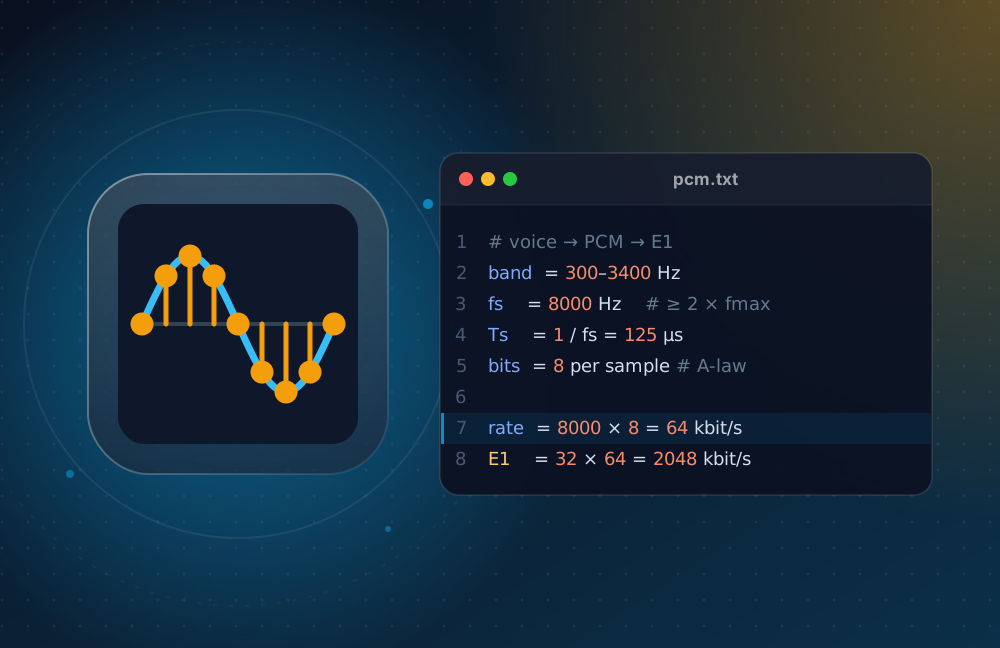
Telecom Fundamentals course — a voice wave and its digitization (PCM)
61 lessons · 3 labs · project
3 practicums · 8 troubleshooting cases
For beginners: no telecom experience needed
Individual
Per month 200 AZN
Group
Per month 150 AZN
Paying for the full course in a group
15% discount
Installments
50/50
Subscription
from 30 AZN a month
The first course of the Telecom track. We start with how any communication works: message, signal, channel and noise. Then you will see how voice becomes numbers (PCM), how 30 calls travel in one digital E1 stream, and why the whole network must share common synchronization. Every topic is an interactive lesson with diagrams and animations, exercises and study notes.

Enrollment for a new group is open — send a request to reserve your seat

Lessons are taught live in Azerbaijani and Russian.

Or study on your own in your personal account → with a subscription from 30 AZN a month

Before you start

No special knowledge is required: school maths (multiplication, division and fractions) is enough. Every term is explained in the lesson where it is first needed.

How the course works

One topic, one lesson: interactive slides with diagrams and animations, exercises with answer checking, and study notes in three languages (az, ru, en). Each lesson has a worked example, a “What can go wrong and how to find it” section, practice and a self-check. Topic blocks end with practicums and labs: voice spectrum and sampling in Audacity, an E1 stream calculator. The course closes with typical faults and a project: the path from a microphone to the exchange, with calculations.

Course outline

Introduction to telecommunications and standards: ITU-T, ETSI, 3GPP, IETF
Sound and the analog signal: frequency, spectrum, decibels, the 300–3400 Hz band, echo
Digitizing voice: sampling, quantization, A-law/μ-law, PCM (G.711), HDB3
Multiplexing and E1/T1 streams: frame, timeslots, TS0 and TS16, CRC-4, alarms
Switching, transport and synchronization: circuit and packet switching, PDH, SDH, WDM, the sync hierarchy
Problems and solutions: 8 cases on E1, line coding, synchronization and SDH protection
Project: the path from microphone to exchange — diagram, calculations, sync plan

The Telecom track

This course opens a track of 14 courses, from the telephone line to 5G: PSTN, ISDN, SS7, IP networks, voice over IP, SIP, NGN, GSM, LTE, IMS, VoLTE, the cloud core (NFV) and 5G.

Next course: The PSTN telephone network

How do we teach?

Learning stages

01

Webinar

Students join the lesson live. At the end of each lesson, students are sent a video recording of the class.
02

Homework

Every assignment is based on the topic covered in the webinar. Homework helps you reinforce the material and understand it better.

03

Working with a mentor

The teacher stays in touch with the group both during the course and outside class. Any questions get answered right away.

04

Portfolio

During the course you'll complete several projects on different topics — they'll show employers what you can do.

Self-paced learning

The full curriculum in your personal account

61 topics with theory, examples and practice. The first 5 are free, the rest come with a subscription. Interactive lessons with slides and coding trainers: 61.

Introduction to telecommunications and standards11 topics
  1. What telecommunications is: message, signal, channel and network
  2. A history of telecommunications: from the telegraph to digital exchanges and mobile networks
  3. Types of networks: fixed, mobile and data networks
  4. Telecom services: voice, SMS, data, video and quality as the subscriber sees it
  5. The Telecom track map: 14 courses and how to take them
  6. Who writes the standards: ITU-T, ETSI, 3GPP, IETF, GSMA, IEEE
  7. ITU-T Recommendations: series, numbers and where to find them
  8. 3GPP: groups, releases and what appeared when
  9. 3GPP specification numbers: TS, TR, series and versions
  10. How to read a specification: structure, shall/should/may, tables and RFCs
  11. Practicum: standards — find, identify the release, read
Sound and the analog signal9 topics
  1. Sound: vibrations, frequency, loudness and the voice spectrum
  2. Microphone and speaker: from sound to current and back
  3. Decibels: dB, dBm and dBm0 — gain and attenuation along the path
  4. Noise and the signal-to-noise ratio
  5. The 300–3400 Hz voice channel: why this band
  6. Attenuation, distortion and crosstalk: why analog does not scale
  7. The hybrid (2-wire/4-wire) and where echo comes from
  8. Tool: Audacity — recording, waveform, spectrum and tone generator
  9. Lab: the voice spectrum and the 300–3400 Hz band in Audacity
Digitizing voice: PCM8 topics
  1. Analog and digital: bits, bytes and why a digital signal is more robust
  2. Sampling: the Nyquist–Shannon theorem and why 8 kHz
  3. Quantization: levels, quantization noise, uniform and non-uniform
  4. Companding with A-law and μ-law: 8 bits per sample
  5. The PCM channel: 8000 × 8 = 64 kbit/s, DS0 and G.711
  6. Line coding: AMI, HDB3 (E1), B8ZS (T1) and why it is needed
  7. Lab: aliasing and quantization noise in Audacity
  8. Practicum: PCM — bit rates, encoding a sample, finding mistakes
Multiplexing and E1/T1 streams12 topics
  1. Frequency-division multiplexing (FDM): many calls on one line
  2. Time-division multiplexing (TDM): frames and timeslots
  3. The E1 frame: 32 timeslots of 8 bits, 125 µs, 2048 kbit/s
  4. TS0: frame alignment with FAS and NFAS
  5. TS16: the 16-frame CAS multiframe or a common signalling channel
  6. The CRC-4 multiframe: error checking and E-bits
  7. E1 physical layer (G.703): 120 Ω and 75 Ω, connectors, cables and cross-connect
  8. E1 alarms: LOS, LOF, AIS, RAI, LOMF and BER
  9. T1/DS1: 24 channels, the F-bit, SF/ESF and 1544 kbit/s
  10. Loopbacks (local and remote) and BER measurement
  11. Lab: an E1/T1 calculator in a spreadsheet — rates, timeslots, capacity
  12. Practicum: E1 — timeslots, calculations, diagnosis by alarms
Switching, transport and synchronization12 topics
  1. Switching: from the manual switchboard to the automatic exchange
  2. Circuit switching: setup, hold and release
  3. Packet switching: header, queue and statistical multiplexing
  4. Circuit vs packet switching: efficiency, delay and quality
  5. PDH: E1 → E2 → E3 → E4 and justification
  6. SDH: STM-1 (155.52 Mbit/s), the VC-12 container and 63 × E1
  7. SDH rings: MSP and SNCP protection, switchover within 50 ms
  8. Optical transport: fiber, wavelengths and WDM
  9. Network synchronization: why exchanges need a common clock, and slips
  10. Synchronization hierarchy: PRC, SSU, SEC; locked, holdover and free-run modes
  11. Jitter and wander: how they differ and what they do
  12. Diagnosing slips: counters, symptoms and the synchronization plan
Problems and solutions9 topics
  1. Case: an LOS alarm after work on the cross-connect
  2. Case: AIS from the transport network — whose alarm is it?
  3. Case: the stream will not come up — CRC-4 is on at one end only
  4. Case: errors caused by 75/120 Ω and the wrong cable
  5. Case: a forgotten loopback — "the stream is up, but no calls"
  6. Case: a line code mismatch — HDB3 at one end, AMI at the other
  7. Case: faxes and modems fail — slips caused by synchronization
  8. Case: short hits during SDH protection switching
  9. Project: the path from a microphone to the exchange — diagram, calculations, synchronization plan, alarm checklist

Group and individual classes include a teacher, homework review and a certificate. The subscription gives you materials, exercises and progress tracking at your own pace, without teacher feedback.

Telecom Fundamentals: Signals, PCM, E1 and Transport: how to enroll

Fill in the form and we will tell you the start date of the next group, the schedule and payment terms. Or come to a free trial lesson first.

WhatsApp