The PSTN Telephone Network: Subscriber Line, DTMF, Exchange, CAS

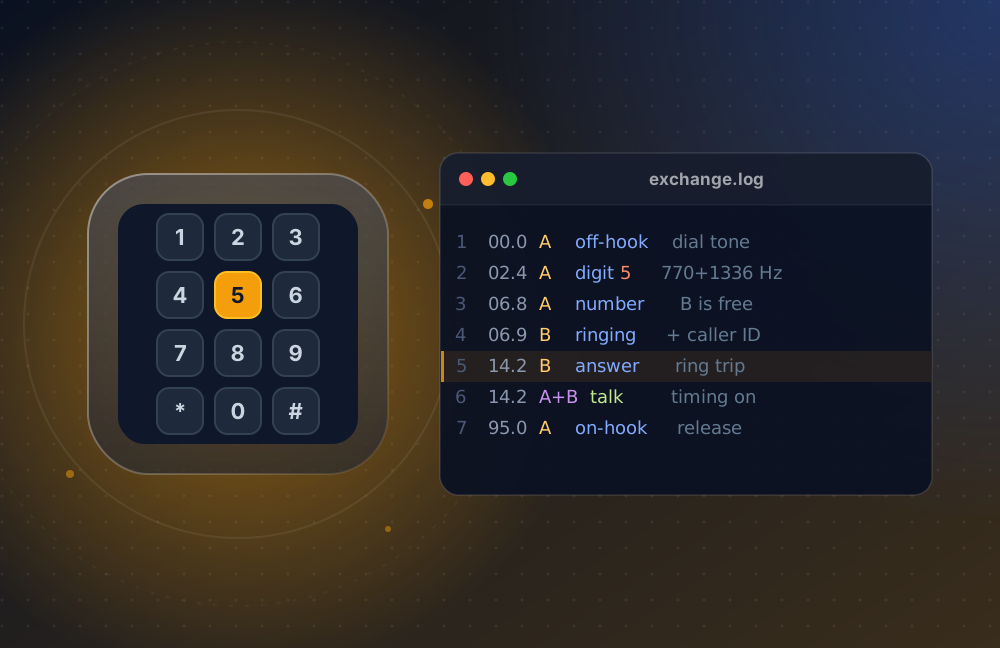
The PSTN Telephone Network course — a DTMF tone-dialing keypad
70 lessons · 4 labs · project
5 practicums · 11 troubleshooting cases
After the Telecom Fundamentals course
Individual
Per month 200 AZN
Group
Per month 150 AZN
Paying for the full course in a group
15% discount
Installments
50/50
Subscription
from 30 AZN a month
How the classic telephone network works. What happens on the line when a handset is lifted; how the exchange receives a number by pulse and DTMF tone dialing, finds the subscriber and connects the call; how numbering and routing work; how exchanges signal each other with CAS and R2, and how the number of circuits is calculated from traffic. ISDN, SS7 and IP telephony are all built on this foundation.

Enrollment for a new group is open — send a request to reserve your seat

Lessons are taught live in Azerbaijani and Russian.

Or study on your own in your personal account → with a subscription from 30 AZN a month

Before you start

Complete Telecom Fundamentals first: the 300–3400 Hz band, PCM and the E1 stream are used here without repeating the explanation.

How the course works

One topic, one lesson: interactive slides, animations and call-flow diagrams (who sends which signal to whom, and in which order), exercises with answer checking, and study notes in three languages (az, ru, en). Each lesson has a worked example, a “What can go wrong and how to find it” section, practice and a self-check. Labs: call progress tones and DTMF in Audacity, exchange routing tables, an Erlang B calculator.

Course outline

PSTN architecture: exchanges, network hierarchy, the subscriber line, PBX
The analog subscriber: loop feeding, tones, ringing, pulse dialing, caller ID, a complete call
DTMF: the frequency matrix, signal parameters, the receiver, DTMF in the speech channel
Numbering: E.164, national plans, number formats, number portability, emergency calls
How an exchange works: the switching matrix, digit analysis and number translation, routes, charging
Inter-exchange signaling before SS7: CAS, ABCD bits, R2 MFC
Traffic and quality: erlangs, the busy hour, Erlang B, trunk dimensioning, KPIs
The access network: concentrators, V5.2, MSAN
Problems and solutions: 11 cases, from no dial tone to R2 interconnects and emergency calls
Project: a city network of 3 exchanges and a PBX

The Telecom track

The second course of the 14-course Telecom track, from the telephone line to 5G.

Previous course: Telecom Fundamentals

Next course: ISDN: BRI and PRI

How do we teach?

Learning stages

01

Webinar

Students join the lesson live. At the end of each lesson, students are sent a video recording of the class.
02

Homework

Every assignment is based on the topic covered in the webinar. Homework helps you reinforce the material and understand it better.

03

Working with a mentor

The teacher stays in touch with the group both during the course and outside class. Any questions get answered right away.

04

Portfolio

During the course you'll complete several projects on different topics — they'll show employers what you can do.

Self-paced learning

The full curriculum in your personal account

70 topics with theory, examples and practice. The first 4 are free, the rest come with a subscription. Interactive lessons with slides and coding trainers: 70.

PSTN architecture7 topics
  1. What the PSTN is and what it is made of
  2. The exchange hierarchy: local, transit, long-distance and international
  3. The local loop: copper pair, cross-connect, cabinet, length and resistance
  4. Types of exchanges: local, transit, PBX and concentrator
  5. Local, regional, long-distance and international calls
  6. Several operators: points of interconnection, transit and settlement
  7. The PBX: extension numbers, outside line access, direct dialling-in (DDI)
The analog subscriber10 topics
  1. The telephone set: microphone, earpiece, ringer, dial and hybrid
  2. Line feeding: −48 V, loop current and the exchange battery
  3. Off-hook and on-hook: closing the loop and detecting it
  4. Call progress tones: dial tone, ringback, busy and congestion (ITU-T E.180)
  5. The ringing signal: frequency, voltage and cadence
  6. Pulse (decadic) dialing: loop breaks at 10 pulses per second
  7. Caller ID (CLIP): FSK data between rings
  8. A complete analog call: from off-hook to hang-up
  9. Line faults: open circuit, short, leakage and "no dial tone"
  10. Lab: call progress tones per E.180 in Audacity and comparing cadences
DTMF: tone dialing6 topics
  1. The DTMF matrix: every key is two tones
  2. DTMF signal parameters: tone and pause duration, levels and twist (ITU-T Q.23, Q.24)
  3. The DTMF receiver: filters, the Goertzel algorithm in plain words, false detections (talk-off)
  4. DTMF inside the voice channel: IVR, post-dialling, passing through the network and DTMF-CLIP
  5. Lab: DTMF in Audacity — generate it, find the frequency pairs in the spectrum, recognise the number
  6. Practicum: DTMF — decode a frequency sequence and find a dialling error
Numbering6 topics
  1. E.164: CC, NDC and SN — at most 15 digits
  2. The national numbering plan: access prefixes, short numbers and emergency services
  3. Number formats: international, national and subscriber (Nature of Address)
  4. Number portability (MNP): routing number and the portability database
  5. Emergency calls in the PSTN: short numbers, priority and location-based routing
  6. Practicum: analysing numbers in different formats
How an exchange works12 topics
  1. Exchange architecture: subscriber modules, switching field, control and interfaces
  2. Space and time switching: the T-S-T structure
  3. Call processing: idle → dialling → routing → ringing → talk → release
  4. Digit analysis: prefix tables and number length
  5. Number translation: adding or removing prefixes and changing the format before sending
  6. Office direction, route, trunk group and circuit
  7. Route priorities, alternative paths and overflow
  8. Charging: CDRs, call timing and tariff zones
  9. Supplementary services: call forwarding, call waiting, conference and barring
  10. Traffic fraud in the PSTN: types and warning signs — an overview
  11. Lab: designing digit analysis, translation and routing tables for a city network
  12. Practicum: routing a call through the tables
Inter-exchange signalling before SS78 topics
  1. Types of signalling: subscriber and inter-exchange, line and register, in-band and out-of-band
  2. Channel-associated signalling (CAS) between exchanges
  3. ABCD bits in TS16: seizure, answer and clear
  4. R2 MFC: forward and backward signals and signal groups
  5. A complete call over R2
  6. National R2 variants and why interconnections fail
  7. CAS limitations: speed, few functions and the weakness of in-band signalling → SS7
  8. Practicum: analysing CAS and R2 signal exchanges
Traffic and quality7 topics
  1. Telephone traffic: the erlang, intensity and mean holding time
  2. The busy hour and the daily traffic profile
  3. The loss model: the Erlang B table and grade of service (GoS)
  4. How many channels and E1 streams: dimensioning trunk groups
  5. Network KPIs: ASR, NER, ABR, ALOC and PDD
  6. Lab: an Erlang B calculator in a spreadsheet — dimensioning trunk groups for directions
  7. Practicum: calculating traffic and trunk groups
The access network2 topics
  1. The access network: concentrators, remote units and the V5.2 interface — an overview
  2. MSAN: POTS, ISDN and DSL in one node; the Huawei MA5600T example
Problems and solutions12 topics
  1. Case: no dial tone for a subscriber
  2. Case: noise and crackling on the line
  3. Case: the IVR does not recognise digits
  4. Case: the caller's number is not displayed
  5. Case: "busy" in the busy hour — not enough channels
  6. Case: a routing loop between exchanges
  7. Case: long-distance calls fail — the number format
  8. Case: an R2 interconnection fails — different national variants
  9. Case: "stuck" CAS channels
  10. Case: direct dialling-in to a PBX does not work
  11. Case: an emergency call goes to the wrong service
  12. Project: a city telephone network — 3 exchanges and a PBX: numbering, translations, routing, trunk groups, signalling and a fault checklist

Group and individual classes include a teacher, homework review and a certificate. The subscription gives you materials, exercises and progress tracking at your own pace, without teacher feedback.

The PSTN Telephone Network: Subscriber Line, DTMF, Exchange, CAS: how to enroll

Fill in the form and we will tell you the start date of the next group, the schedule and payment terms. Or come to a free trial lesson first.

WhatsApp