ISDN: BRI and PRI, Q.921 and Q.931

The ISDN course — 2B+D channels on one line
62 lessons · 3 labs · project
4 practicums · 12 troubleshooting cases
After The PSTN Telephone Network course
Individual
Per month 200 AZN
Group
Per month 150 AZN
Paying for the full course in a group
15% discount
Installments
50/50
Subscription
from 30 AZN a month
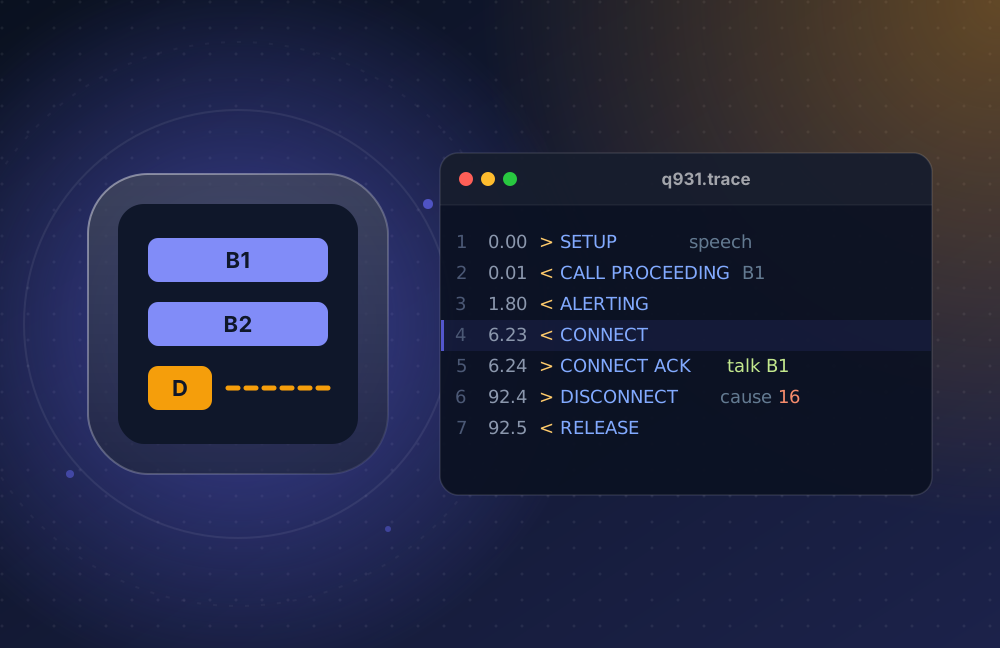
How the Integrated Services Digital Network works. Two B channels (voice or data) and a separate D channel for signaling on one line; BRI for homes and offices, PRI over E1 for PBXs and operators; Q.921 (LAPD) and Q.931 (DSS1) messages on the D channel; cause values (Q.850) and finding real faults from call traces. BRA and PRA on Huawei equipment, following the product documentation.

Enrollment for a new group is open — send a request to reserve your seat

Lessons are taught live in Azerbaijani and Russian.

Or study on your own in your personal account → with a subscription from 30 AZN a month

Before you start

Complete Telecom Fundamentals and The PSTN Telephone Network first: PCM, the E1 stream, numbering, PBXs and routing are used here without repeating the explanation.

How the course works

One topic, one lesson: interactive slides, animations and call-flow diagrams (who sends which message to whom, and in which order), exercises with answer checking, and study notes in three languages (az, ru, en). Each lesson has a worked example, a “What can go wrong and how to find it” section, practice and a self-check. Labs: reading Q.921 and Q.931 text traces, a plan for connecting a PBX over two PRIs.

Course outline

The idea of ISDN: B and D channels, the reference model (TE, NT, the R/S/T/U points), services, protocol layers
BRI (BRA): 2B+D, the U interface, the S0 bus, D-channel access, activation, MSN, BRA on the Huawei UA5000
PRI (PRA): 30B+D on E1, connecting a PBX, channel numbering, DDI, synchronization
Q.921 (LAPD): the frame, SAPI and TEI, TEI assignment, frame types, LAPD link establishment
Q.931 (DSS1): message structure, from SETUP to RELEASE COMPLETE, call states, information elements, timers
Q.850 causes: the Cause element, common causes, from a cause value to the problem
Huawei practice: MML, safe working, configuring and verifying PRA on the MSOFTX3000
Problems and solutions: 12 cases, from a D channel that will not come up to cause values and clocking
Project: connecting a PBX over PRI and an office over BRI

The Telecom track

The third course of the 14-course Telecom track, from the telephone line to 5G.

Previous course: The PSTN Telephone Network

Next course: SS7 Signalling

How do we teach?

Learning stages

01

Webinar

Students join the lesson live. At the end of each lesson, students are sent a video recording of the class.
02

Homework

Every assignment is based on the topic covered in the webinar. Homework helps you reinforce the material and understand it better.

03

Working with a mentor

The teacher stays in touch with the group both during the course and outside class. Any questions get answered right away.

04

Portfolio

During the course you'll complete several projects on different topics — they'll show employers what you can do.

Self-paced learning

The full curriculum in your personal account

62 topics with theory, examples and practice. The first 4 are free, the rest come with a subscription. Interactive lessons with slides and coding trainers: 62.

The idea of ISDN5 topics
  1. Why a digital subscriber line: the limits of the analog line
  2. ISDN channels: B, D and H
  3. The reference model: TE, TA, NT1, NT2, LT/ET and the R, S, T, U points
  4. ISDN services: bearer services, teleservices, supplementary services
  5. ISDN protocol layers: I.430/I.431, Q.921, Q.931 (DSS1)
BRI (BRA)7 topics
  1. BRI (BRA): 2B+D and the 144 kbit/s rate
  2. The U interface: two wires, 2B1Q and 4B3T codes, 160 kbit/s
  3. The S0 bus: four wires, 192 kbit/s, up to 8 terminals
  4. How terminals share the D channel: echo bits and priorities
  5. Layer 1 activation: the INFO 0–4 signals
  6. MSN: several numbers on one BRI line
  7. BRA on the Huawei UA5000: P2P and P2MP
PRI (PRA)7 topics
  1. PRI (PRA): 30B+D on E1 and 23B+D on T1
  2. Connecting a PBX over PRI: the user side and the network side
  3. PRI channel numbering: B1–B30 and timeslots TS1–15, TS17–31
  4. Direct dialling-in (DDI) over PRI: which digits the operator sends
  5. Clocking on PRI: who is the master and who is the slave
  6. Protocol variants: ETSI DSS1, QSIG (overview), NFAS on T1
  7. Practicum: channels, rates and the roles of the sides
Layer 2: Q.921 (LAPD)6 topics
  1. The LAPD frame: flag, address, control field, data, FCS
  2. SAPI (0, 16, 63) and TEI (fixed, automatic, 127)
  3. TEI assignment: ID Request / ID Assigned
  4. LAPD frame types: I, S (RR, RNR, REJ), U (SABME, UA, DISC, DM, FRMR, UI)
  5. Establishing a LAPD link: SABME/UA, N(S)/N(R), timers T200/T203
  6. Lab: reading a Q.921 text trace — link up, exchange and teardown
Layer 3: Q.931 (DSS1)14 topics
  1. Q.931 message structure: protocol discriminator, call reference, message type, IEs
  2. Q.931 message groups: establishment, information phase, clearing, miscellaneous
  3. SETUP in detail: mandatory and optional IEs
  4. SETUP ACKNOWLEDGE, CALL PROCEEDING, ALERTING, PROGRESS
  5. CONNECT and CONNECT ACKNOWLEDGE
  6. DISCONNECT, RELEASE, RELEASE COMPLETE: three-step clearing
  7. Call states on the user and network side (U/N), simplified
  8. Bearer capability: speech, 3.1 kHz audio, 64 kbit/s unrestricted
  9. Channel identification: channel selection, preferred and exclusive
  10. Called/Calling party number: type of number, numbering plan, presentation and screening
  11. Progress indicator, Display, Keypad facility: call progress, display text, keypad
  12. Q.931 timers: T303, T305, T308, T310, T313
  13. Supplementary services in DSS1: CLIP/CLIR, COLP/COLR, hold, call diversion
  14. Lab: reading a Q.931 text trace — a successful call and a rejected call
Cause values (Q.850)4 topics
  1. The Cause IE: location, class, value
  2. Common causes and what they mean
  3. From a cause value to the problem: what to check
  4. Practicum: decoding causes from traces
Huawei practice5 topics
  1. LMT and the MML format: ADD, MOD, RMV, LST, DSP, parameters and the response
  2. Working safely: LST before a change, backup, rollback
  3. PRA to a PBX on the MSOFTX3000: ADD PRALNK, ADD PRATG, ADD PRATKC
  4. Verifying PRA: status commands and PRA tracing
  5. Lab: a plan for connecting a PBX over two PRIs — channels, numbering, clocking, an MML script
Problems and solutions14 topics
  1. Case: the D channel will not come up — both sides are "network"
  2. Case: BRI — the TEI is not assigned
  3. Case: cause 34 — no circuit/channel available
  4. Case: cause 28 — invalid number format
  5. Case: cause 1 — unallocated number: where the routing error is
  6. Case: cause 111 — incompatible protocol variants
  7. Case: mismatched channel numbering on PRI
  8. Case: the number is not shown — presentation and screening
  9. Case: the PBX sends overlap, the exchange expects en bloc
  10. Case: DDI — the PBX receives the wrong digits
  11. Case: clicks and errors on PRI caused by clocking
  12. Case: a "flapping" PRI: E1 alarms and their link to the D channel
  13. A general ISDN troubleshooting order: layers 1 → 2 → 3
  14. Project: connecting a PBX over PRI and an office over BRI — plan, MML script, call ladder, test checklist

Group and individual classes include a teacher, homework review and a certificate. The subscription gives you materials, exercises and progress tracking at your own pace, without teacher feedback.

ISDN: BRI and PRI, Q.921 and Q.931: how to enroll

Fill in the form and we will tell you the start date of the next group, the schedule and payment terms. Or come to a free trial lesson first.

WhatsApp