SS7 Signalling: MTP, ISUP, SCCP, TCAP

The SS7 Signalling course — a separate signalling network between exchanges
95 lessons · 5 labs · project
8 practicums · 14 troubleshooting cases
After the ISDN course
Individual
Per month 200 AZN
Group
Per month 150 AZN
Paying for the full course in a group
15% discount
Installments
50/50
Subscription
from 30 AZN a month
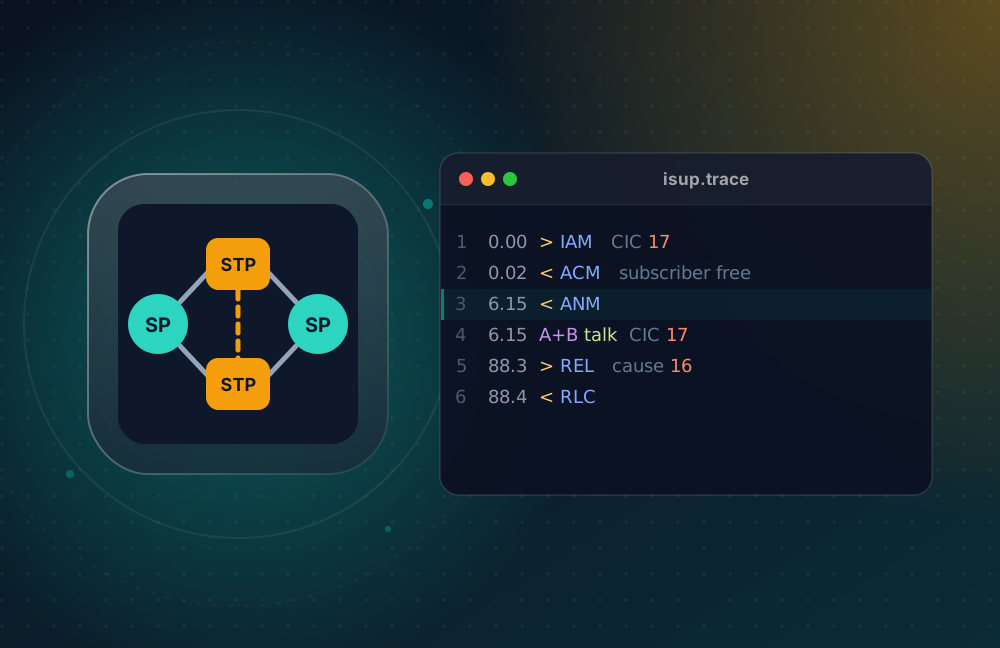
How operator exchanges “talk” to each other. SS7 (Signalling System No. 7) is a signalling network kept apart from the voice channels: signalling points, STPs and links; the MTP levels, point codes and routing; setting up and clearing calls with ISUP messages; SCCP and Global Title; TCAP and the Intelligent Network (INAP). Finding real faults from traces and configuring SS7 on the Huawei MSOFTX3000, following the product documentation.

Enrollment for a new group is open — send a request to reserve your seat

Lessons are taught live in Azerbaijani and Russian.

Or study on your own in your personal account → with a subscription from 30 AZN a month

Before you start

Complete Telecom Fundamentals, The PSTN Telephone Network and ISDN first: the E1 stream, numbering, routes, CAS, Q.931 and Q.850 causes are used here without repeating the explanation.

How the course works

One topic, one lesson: interactive slides, animations and message-flow diagrams (who sends which message to whom, and in which order), exercises with answer checking, and study notes in three languages (az, ru, en). Each lesson has a worked example, a “What can go wrong and how to find it” section, practice and a self-check. Labs: reading MTP2, MTP3 and ISUP text traces, designing GTT tables and an SS7 network.

Course outline

SS7 basics: common-channel signalling, network elements (SP, SSP, STP, SCP), signalling modes, links and routes, link types, STP mated pairs
Signalling point codes: OPC and DPC, the ITU (14-bit) and ANSI (24-bit) formats, the network indicator
MTP1 and MTP2: the signalling data link, FISU, LSSU and MSU, link alignment, error correction and error monitoring
MTP3: the routing label, routing tables, SLS load sharing, changeover when a link fails, TFP and TFA, congestion
ISUP: CIC, IAM, ACM, ANM, REL and RLC, a complete call, timers, circuit blocking and continuity checks
ISUP parameters and interworking: numbers, the calling party category, Q.931 to ISUP interworking, variants, supplementary services, number portability
SCCP: protocol classes, the address, Global Title and its translation (GTT), messages and segmentation
TCAP and the Intelligent Network: transactions and components, INAP, freephone and prepaid
Huawei practice: the SS7 data model in the MSOFTX3000, destinations, links, routes and trunk groups, verification and tracing
Problems and solutions: 14 cases, from a link that will not align to CIC mismatches, TFP, GTT and TCAP Abort
Project: an SS7 network of 3 exchanges and an STP mated pair

The Telecom track

The fourth course of the 14-course Telecom track, from the telephone line to 5G.

Previous course: ISDN

Next course: IP Networks for Telecom Engineers

How do we teach?

Learning stages

01

Webinar

Students join the lesson live. At the end of each lesson, students are sent a video recording of the class.
02

Homework

Every assignment is based on the topic covered in the webinar. Homework helps you reinforce the material and understand it better.

03

Working with a mentor

The teacher stays in touch with the group both during the course and outside class. Any questions get answered right away.

04

Portfolio

During the course you'll complete several projects on different topics — they'll show employers what you can do.

Self-paced learning

The full curriculum in your personal account

60 topics with theory, examples and practice. The first 4 are free, the rest come with a subscription. Interactive lessons with slides and coding trainers: 60.

SS7 basics9 topics
  1. Why SS7: common-channel signalling versus CAS
  2. Names and standards: SS7, CCS7, No.7; ITU-T Q.700 and ANSI
  3. SS7 network elements: SP, SSP, STP, SCP
  4. Signalling modes: associated, quasi-associated, non-associated
  5. Link, linkset, route and route set
  6. Link types: A, B, C, D, E, F
  7. STP mated pairs and redundancy
  8. The SS7 stack and the OSI model
  9. International and national SS7 networks, gateway exchanges
Signalling point codes4 topics
  1. Point codes: OPC and DPC, an exchange's address in the signalling network
  2. The ITU point code: 14 bits, the 3-8-3 format, decimal and hex notation
  3. The ANSI point code (24 bits, 8-8-8), national formats and the network indicator
  4. Practicum: signalling point codes
MTP1 and MTP29 topics
  1. MTP1: the signalling data link, 64 kbit/s, 56 kbit/s and 2 Mbit/s
  2. Signal units FISU, LSSU and MSU: why three kinds
  3. Signal unit fields: flag, BSN/BIB, FSN/FIB, LI, SIO, SIF, CK
  4. LSSU status indications: SIO, SIN, SIE, SIOS, SIPO, SIB
  5. Link alignment: normal and emergency, the proving period
  6. Error correction: the basic method and PCR
  7. Error monitoring: SUERM and AERM, when a link is taken out of service
  8. Lab: reading an MTP2 trace — alignment, FISU, MSU, retransmission
  9. Practicum: signal units and the alignment process
MTP312 topics
  1. MTP3 functions: message discrimination, distribution and routing
  2. The SIO: the service indicator (SNM, SNT, SCCP, TUP, ISUP …) and the network indicator
  3. The routing label: DPC, OPC, SLS
  4. MTP3 routing tables and priorities
  5. SLS load sharing, combined linksets
  6. Changeover and changeback: COO/COA, CBD/CBA
  7. Transfer prohibited and allowed (TFP, TFA, TFR), route set test (RST)
  8. The signalling link test: SLTM/SLTA
  9. Link congestion: levels, the reaction of MTP3 and its users
  10. Signalling link load: calculation and norms
  11. Lab: reading an MTP3 trace — routing via an STP, a link failure, TFP
  12. Practicum: routing a message and the network reaction to a failure
ISUP: messages and the call17 topics
  1. ISUP and TUP: their place in the stack and their tasks
  2. CIC: tying a message to a voice circuit, agreeing the CIC on both sides
  3. The ISUP message format: CIC, message type, mandatory and optional parameters
  4. IAM in detail
  5. SAM: en bloc and overlap signalling
  6. ACM and the backward call indicators
  7. CPG: alerting, progress, in-band information
  8. ANM and CON: the called party answers
  9. REL and RLC: release and the cause
  10. SUS/RES: suspend and resume
  11. A complete call via two exchanges and an STP
  12. ISUP timers: T1, T5, T7, T9 and others
  13. Circuit supervision: BLO/BLA, UBL/UBA, CGB/CGBA, CGU/CGUA, RSC, GRS/GRA
  14. Continuity check: COT, CCR
  15. ISUP overload: automatic congestion control (ACC)
  16. Lab: reading an ISUP trace — a successful call, busy, no answer
  17. Practicum: reconstructing a call from its messages
ISUP: parameters and interworking6 topics
  1. Numbers in ISUP: nature of address, NPI, presentation and screening
  2. Forward call indicators and the calling party category
  3. Q.931 ↔ ISUP interworking: SETUP↔IAM, ALERTING↔ACM, CONNECT↔ANM
  4. ISUP variants: ITU ISUP 92/97, ANSI ISUP, national variants — an overview
  5. Supplementary services in ISUP: CLIP/CLIR, call diversion (redirecting number)
  6. Number portability in ISUP: the routing prefix and parameters
SCCP3 topics
  1. Why SCCP: addressing applications without tying them to circuits
  2. SCCP protocol classes 0–3
  3. The SCCP address: SSN, GT, PC and the routing indicator

Group and individual classes include a teacher, homework review and a certificate. The subscription gives you materials, exercises and progress tracking at your own pace, without teacher feedback.

SS7 Signalling: MTP, ISUP, SCCP, TCAP: how to enroll

Fill in the form and we will tell you the start date of the next group, the schedule and payment terms. Or come to a free trial lesson first.

WhatsApp