
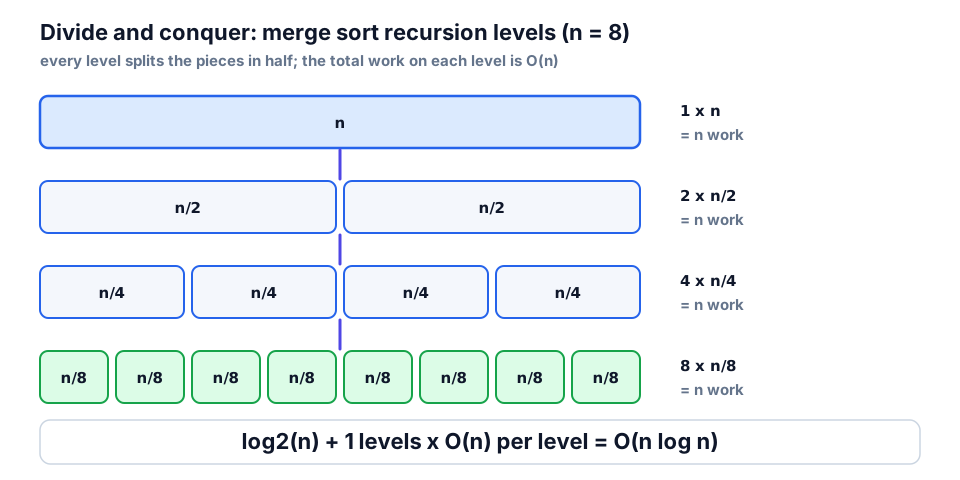
Divide and conquer splits a problem into independent smaller problems of the same kind, solves each recursively and combines the answers.
Three steps
- Divide: split the problem (usually into two halves).
- Conquer: solve each part recursively; the smallest part (the base case) is solved directly.
- Combine: build the overall answer from the parts' answers.
The parts do not overlap, which separates this approach from dynamic programming, where subproblems repeat.
Example: recursive maximum
def max_rec(a, lo, hi):
    if lo == hi:                          # base case: one item
        return a[lo]
    mid = (lo + hi) // 2
    left = max_rec(a, lo, mid)            # solve the left half
    right = max_rec(a, mid + 1, hi)       # solve the right half
    return max(left, right)               # combine

data = [3, 9, 2, 7, 5, 8]
print(max_rec(data, 0, len(data) - 1))
The recurrence is T(n) = 2T(n/2) + O(1), so the cost is O(n), the same as a plain loop. The example only shows the pattern.
